Business casual explained: dress code, rules, and outfit ideas
If the dress code is unclear, business casual can feel like a trap: too formal and you look out of place; too relaxed and you look unprofessional. The goal is a safe baseline you can adjust—clear rules, clear boundaries, and repeatable outfits you can use right away.
What is business casual (and what it is not)
Business casual definition in plain English
A practical business casual definition is: office-appropriate clothes that look intentional, neat, and professional, without requiring a matching suit and tie. In other words, the business casual meaning is “polished separates”—shirts, chinos or tailored trousers, knitwear, and smart shoes that look chosen on purpose.
Define business casual vs “casual” and vs suits
If you’re thinking, “what’s business casual” compared with weekend clothes, the key difference is structure and finish. To define business casual, picture the middle lane between a full suit and truly casual outfits: you’re not in a hoodie and running shoes, and you’re not in a formal suit and tie either.
It helps to think in categories:
- Casual business in everyday conversation often just means “not a suit,” but workplaces usually still expect a collared top, cleaner lines, and better shoes.
- Casual is comfort-first with low structure (tees, sweats, sporty sneakers).
- Business casual attire is workplace-ready: tidy, coordinated, and more tailored.
- Suits (especially with a tie) signal the highest formality.
The same garment can slide up or down depending on fit, fabric, and footwear.
What “too casual” looks like in an office context (clear red flags)
Most “too casual” mistakes are easy to spot because they read sporty, worn-in, or loud. Even in relaxed offices, these are common red flags for business casual dressing:
- Gym sneakers, running shoes, or sandals
- Graphic tees, novelty prints, or big logos
- Ripped or heavily faded jeans, cargo pockets, or sweatpants
- Wrinkled shirts, stretched collars, or pilling knits
The key rules of business casual (so you never look underdressed)
Fit first: business casual fit and why it changes the formality level
Fit is the fastest way to look more professional without replacing your wardrobe. A clean shoulder line, sleeves that don’t swallow your hands, and trousers that sit correctly at the waist make simple business casual wear look considered. Too tight can read attention-grabbing; too loose reads careless—aim for an easy, neat silhouette.
Because standards vary by office, fit is also a dial: slightly trimmer and more structured reads more “office,” while a touch more relaxed can still work in casual business wear environments if it looks intentional and tidy.
Fabric and finish: what reads “office-appropriate”
In professional business casual settings, fabric does a lot of the work. Matte cotton, wool, and refined knits tend to look more workplace-appropriate than shiny synthetics or very rugged, outdoorsy textures. Details matter: a crisp collar, a smoother chino, or a fine-gauge sweater can make an outfit feel “work-ready” even without a blazer.
Also remember that color and material interact. Navy cotton looks softer than navy wool; the same gray can look dressy in flannel and casual in faded denim.
Shoes decide the outfit: the easiest way to dress business casual
If you’re unsure how to dress business casual, start with your shoes. Leather derbies, loafers, and sleek leather boots can make a simple shirt-and-chinos combination read office-appropriate, while athletic shoes pull the same outfit down into weekend territory. Condition matters too—dirty or heavily scuffed shoes can make otherwise solid business casual clothes look rushed.
Color strategy: office-safe palettes and when to add personality
For business casual style, start with a calm base and add personality in small, controlled ways. Reliable palettes include navy/white, gray/blue, olive/cream, and brown/blue. They’re easy to rotate through the week without feeling repetitive, and they photograph well in offices with harsh lighting.
If you want stronger color, keep it to one item (a knit, a shirt, or socks) while the rest stays quiet. Texture changes formality too: a smooth poplin shirt reads sharper than rugged chambray, even in similar shades.
Business casual clothes: the core pieces that cover most offices
Think of this as business casual clothing built into a small, flexible rotation. These business casual menswear staples mix easily, and they’re adaptable because the “right” level still depends on your workplace culture and role.
Tops: OCBDs, dress shirts, polos, fine-gauge knits
Start with OCBDs and simple dress shirts (white, light blue, subtle stripe). Polos can work as casual business attire in many offices when the collar is structured and the fabric isn’t flimsy or clingy. Fine-gauge merino or cotton knits are also excellent: they keep a clean neckline and look finished under office lighting.
Layers: unstructured blazers, sweaters, overshirts, lightweight jackets (when allowed)
Unstructured blazers are the most adaptable: they add shape like tailoring without feeling like a full suit. Sweaters (crewneck or V-neck), tidy overshirts, and minimal lightweight jackets can also work where your workplace accepts outerwear-as-layering—just keep the materials refined and the fit clean.
Bottoms: chinos, wool trousers, dark denim (only where accepted)
Chinos and wool trousers cover almost every office. Dark denim can be acceptable as casual business clothes, but only where it’s already normal—and it should be dark, clean, and free of distressing. If you’re unsure, chinos are the safer baseline than light-wash jeans.
Footwear and belts: how to match the level of polish
Match belt and shoes in a similar tone (they don’t have to be identical). A simple leather belt plus leather shoes signals “work.” Braided belts and canvas sneakers lean casual. If your outfit feels borderline, upgrading footwear is usually the quickest fix.
Accessories and grooming: small signals that read professional
Small signals add up. A simple watch, a tidy bag, clean nails, and maintained hair/facial hair support a business casual look without making it fussy. The point isn’t to be flashy—it’s to look ready to step into a meeting on short notice.
Business casual outfits you can copy (realistic formulas)
If you want business casual inspo that doesn’t feel costume-y, rely on formulas instead of chasing “perfect outfits.” The point of business casual outfits is repeatability: swap one item at a time while keeping the overall level consistent. Use the business casual ideas below as a baseline, then adjust up or down for your office.
The “safe in almost any office” business casual outfit
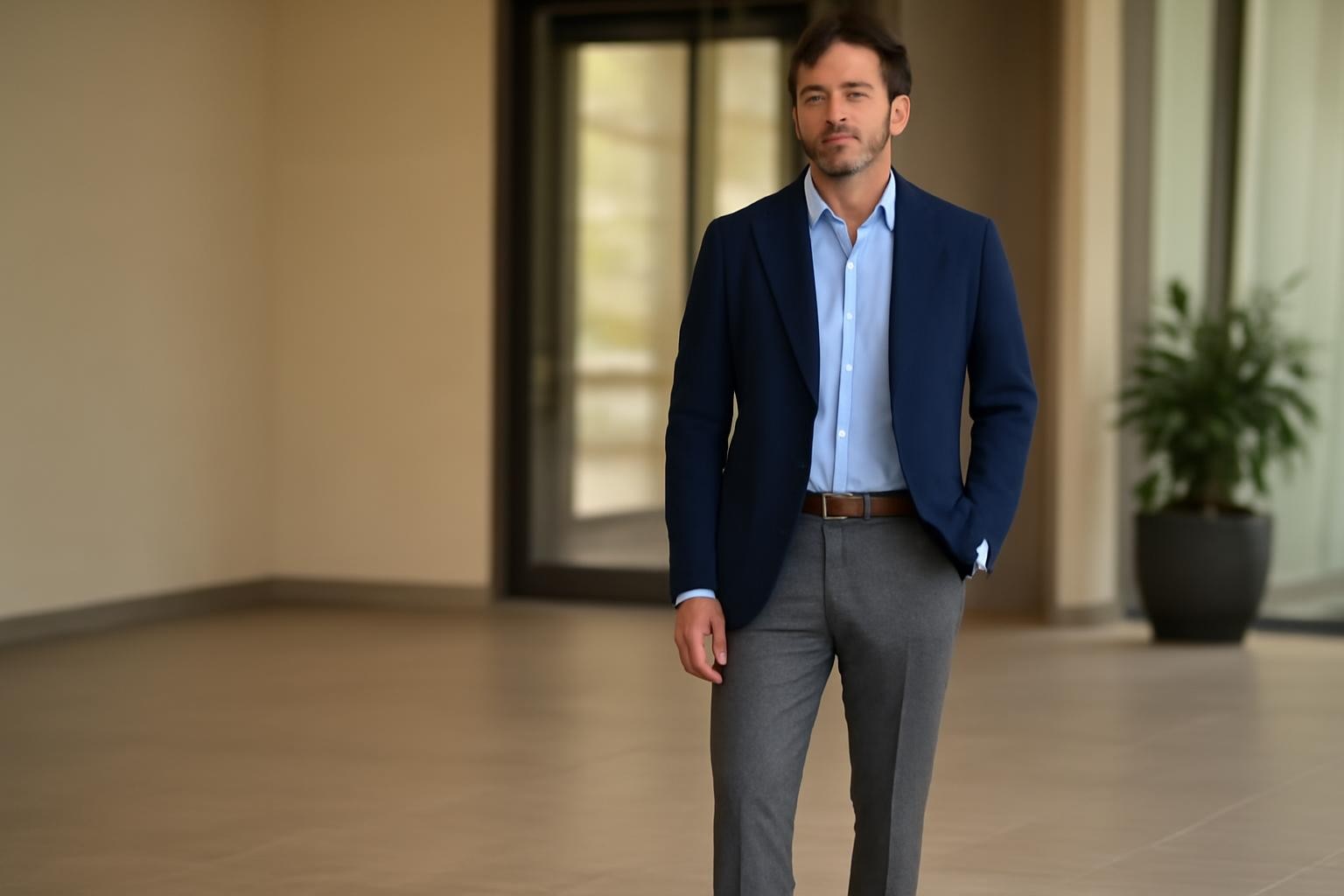
This business casual outfit is hard to get wrong: light blue OCBD, navy chinos or gray wool trousers, brown leather derbies or loafers, and a simple belt. If you need a layer, add a fine-gauge crewneck sweater in navy, charcoal, or camel.
Smart, client-ready: smart business casual with a blazer
For smart business casual, add tailoring without going full suit: an unstructured navy blazer, a white or light blue dress shirt, mid-gray trousers or dark chinos, and dark brown loafers/derbies. Keep patterns subtle (micro-checks, thin stripes) and let clean lines do the work.
Warm-weather: breathable casual business attire that still looks sharp
In heat, the goal is lighter fabrics, not less polish. Try a short-sleeve knit polo (or a crisp pique polo), lightweight chinos, and loafers. Linen can work if it’s tightly woven or blended and the rest of the outfit is sharp; otherwise it can look rumpled fast in an office setting.
This is where casual business outfits can be done well: breathable pieces, but still structure at the collar and a finished shoe. In more relaxed workplaces, dark, clean jeans may substitute for chinos—just keep the top and shoes more refined.
Cold-weather: layering business casual clothing without looking bulky
Cold weather rewards layers that are thin but warm. Start with an OCBD, add a merino sweater, then a blazer or a clean wool coat for commuting. Choose trousers with a bit more weight (flannel, brushed cotton) and leather boots that look sleek rather than rugged.
One rule that helps: keep at least one layer structured (a blazer, a sharp sweater, or a clean coat) so the outfit still reads business casual rather than weekend layering.
Creative office: business casual looks with controlled personality
In creative workplaces, business casual looks can handle more texture and color—just keep the silhouette and materials office-ready. Try a tonal outfit (charcoal shirt with charcoal trousers) with a contrasting shoe, or a patterned knit under a simple blazer.
If you’re searching for business casual fashion or even trendy business casual, translate “trend” into “current but controlled”: slightly wider (not baggy) trousers, a textured knit polo, a softer-shouldered blazer, or a minimalist leather sneaker only if your office already accepts it.
Business travel/conference day: comfortable but professional business casual
For travel, prioritize comfort that still reads well in person and in photos. A knit polo or OCBD, a stretch chino, and loafers (or sleek lace-up shoes) covers most situations. Add a cardigan or unstructured blazer that won’t look awkward if it picks up a few wrinkles in transit.
This is a reliable casual business wear formula, and it can double as a casual business outfit after hours by swapping to a more relaxed layer.
Business casual examples: what to wear by workplace and dress-code signals
Traditional office vs tech/creative vs field-adjacent roles
Different workplaces allow different business casual styles, even under the same label. In a traditional office, expect dress shirts, wool trousers, and leather shoes. In tech or creative settings, knit polos, dark denim, and clean minimal shoes may be normal. In field-adjacent roles, sturdier fabrics may appear day-to-day, but the “meeting version” still needs polish.
A concrete business casual example: in a bank’s back office, chinos + OCBD + derbies is usually safer than denim; in a startup, the same outfit might be “dressed up,” and a knit polo with dark jeans could be typical.
“Business smart casual” at work: what people usually mean
You’ll sometimes hear business smart casual used to nudge the standard slightly upward—closer to tailoring, cleaner shoes, and fewer sporty pieces. It often overlaps with “smart business casual,” meaning: add a blazer, sharpen the shoe choice, and keep colors more conservative.
Because labels vary by company and region, treat the term as a hint, not a universal rule. Most of the time it means “more polished than our usual business casual attire,” especially for client-facing moments.
Reading the room fast: meetings, client days, Fridays, and first-week dressing
When you’re new, dress one notch sharper than you think you need, then recalibrate. Scan shoes first (sneakers vs leather), then collars/layers (tees vs collared shirts), then trousers (denim vs chinos vs wool). Fridays can be looser, but “looser” should still look intentional.
For client days, move toward blazer plus cleaner shoes. For internal days, a knit and chinos may be enough. If you’re unsure, use neutral colors and avoid the most casual materials.
Common mistakes (and the quick fixes)
The “too casual business” trap: items that break the dress code
The phrase “casual business” confuses people because it sounds like “anything casual is fine.” In many workplaces, it isn’t. Athletic sneakers, hoodies, graphic tees, and distressed denim tend to break the business casual line because they look leisure-first.
Quick fix: keep your comfortable base (chinos, knit top) but swap to leather shoes and add a structured collar or a sharper layer.
The “trying too hard” trap: overly formal pieces that look out of place
Overdressing can also feel awkward: a shiny worsted suit, a very formal tie, or patent-leather shoes can look like you’re headed to a wedding, not a normal workday. In laid-back offices, extremely formal tailoring can read like you missed the point of the dress code.
Quick fix: split the suit. Wear the blazer with chinos, or wear the suit trousers with a fine knit and no tie, to land back in the middle.
Proportion and coordination errors that make outfits look sloppy
Common issues include shirts that balloon at the waist, trousers that puddle at the shoes, loud contrast that feels accidental, or mixing too many competing textures at once. Another frequent miss is pairing a very casual shoe with otherwise polished pieces (or the reverse).
Quick fix: simplify the palette, keep one “statement” item at most, and make sure hems and sleeves look intentional.
A simple checklist to dress business casual tomorrow
5-point checklist before you leave (fit, polish, balance, context, comfort)
Use this as your business casual guide for mornings when you don’t want to guess. Before you walk out the door, check:
- Fit: shoulders aligned, sleeves reasonable, trousers sitting correctly
- Polish: shoes clean, belt intentional, shirt presentable (and not visibly wrinkled)
- Balance: if one piece is casual, the rest should be sharper
- Context: client day vs internal day vs Friday vs first week
- Comfort: you can sit, move, and work all day without fussing
If you can answer those five points, you can dress business casual with confidence even when the label is vague.
3 quick upgrade moves and 3 quick casual-down moves
When you need to adjust fast, use small swaps. For dressing business casual more sharply:
- Add an unstructured blazer or a fine-gauge sweater over a collared shirt
- Swap to leather derbies/loafers and make sure they’re clean
- Move from chinos/denim to wool trousers in a neutral color
To relax the level without losing the “work” signal:
- Drop the blazer and keep the collared shirt (or a knit polo) neat
- Choose chinos over wool trousers, keeping the fit clean
- Use softer textures and lighter colors while keeping shoes tidy
These tweaks also help when you’re trying to build business casual looks from what you already own, rather than buying new items.
Frequently Asked Questions About business casual
Can jeans be business casual for men?
Sometimes. Dark, clean, non-distressed jeans in a straight or slim fit can pass in offices that already accept denim. The safer route is chinos or wool trousers, especially for first days, client meetings, or more traditional workplaces. If you wear jeans, upgrade the shoes and keep the top polished.
Are polos business casual, or are they too casual for most offices?
Polos can be business casual in many workplaces, especially in warm weather or less formal offices. Choose a structured collar, solids or subtle patterns, and a clean fit. Pair with chinos or tailored trousers and leather shoes. In stricter offices, lean toward an OCBD or dress shirt instead.
Do you need a blazer for business casual meetings with clients?
Not always, but a blazer is one of the simplest ways to look client-ready when you’re unsure. If your office is relaxed, a blazer over an OCBD with chinos can read professional without looking like a full suit. In very casual environments, a fine-gauge sweater or tidy overshirt can be enough.
What shoes are safest for business casual if you’re not sure how strict the office is?
Leather derbies or loafers in brown or dark brown are usually the safest middle ground. Keep them clean and reasonably polished. Avoid athletic sneakers and overly chunky casual shoes when you’re unsure. If the office is more formal, lean darker (oxblood or black) and simpler in design.